Your Algorithm Doesn't Know What You're Missing: The Slow Death of Musical Surprise
There's a specific kind of magic that older music heads love to talk about. A late-night radio DJ in Chicago spins a track from a Malian kora player between two soul records. A teenager in suburban Ohio flips through the import section at a record shop and picks up a sleeve because the cover art is wild. Someone's older cousin plays a cassette at a house party and nobody knows what language it's in, but everyone's moving. These weren't curated moments. They were accidents — and those accidents changed lives.
That kind of serendipity is getting harder to find. Not because the music isn't there. It absolutely is. Spotify alone claims access to over 100 million tracks, and a genuinely staggering portion of that catalog represents artists from every corner of the planet. The problem isn't availability. The problem is that the system built to surface all that music has a very specific idea of who you are — and it's not particularly interested in surprising you.
The Comfort Trap
Here's how it works, roughly. You stream a few tracks you love. The platform's recommendation engine notes the tempo, key, instrumentation, and listening behavior of millions of users who share your taste profile. It builds a feedback loop. Every playlist it generates nudges you a little further into the center of your own preferences, tightening the circle with each session.
On paper, that sounds great. You get more of what you like. But music discovery — especially the discovery of global sounds — has historically relied on friction. On the slightly uncomfortable feeling of hearing something you don't immediately understand. On giving an unfamiliar rhythm time to make sense. Algorithms are not built for patience. They're built for retention, and retention means keeping you comfortable.
The result is a strange paradox: we've never had more access to world music, and yet many American listeners are arguably hearing less of it in any meaningful, context-rich way than they did thirty years ago.
What Radio Actually Did
It's easy to romanticize radio, but there's something worth taking seriously in what it accomplished culturally. Freeform and college radio stations in the '70s, '80s, and '90s functioned as one-person curatorial operations. A single DJ with strong opinions and a crate of records could expose thousands of listeners to Afrobeat, cumbia, or bhangra in a single broadcast block — not because an algorithm determined those listeners had adjacent taste profiles, but because the DJ thought it was worth hearing.
Programs like KCRW's Morning Becomes Eclectic or late-night slots on college stations across the country became famous precisely for this kind of editorial courage. You tuned in not knowing what was coming. That uncertainty was the point. It created shared listening experiences that crossed genre and geography, and it gave international artists a pipeline into American ears that didn't depend on them already having a following.
Algorithms don't take risks like that. They hedge.
The Record Store as Cultural Portal
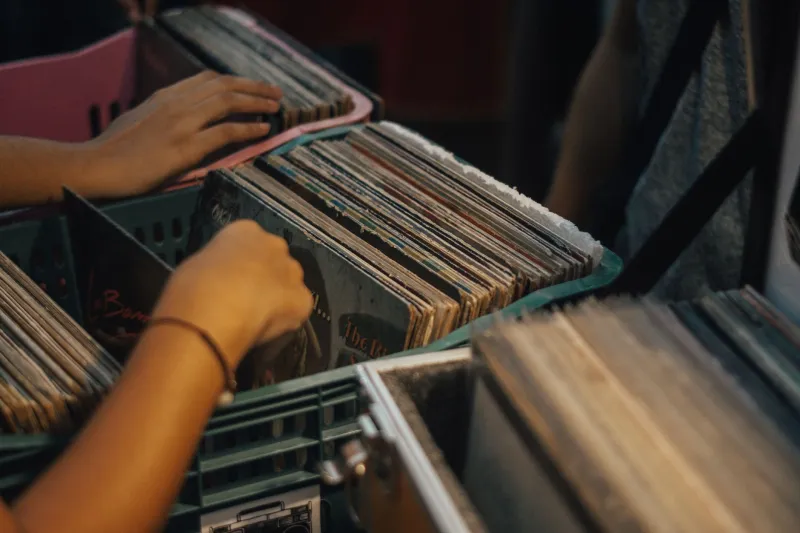
Walk into a well-stocked independent record shop in any major American city before the mid-2000s and you'd find a world section that functioned like a passport. Curious shoppers — especially younger ones with limited budgets who had to choose carefully — would pick up records based on cover art, liner notes, or a handwritten staff recommendation card. The physical act of browsing created collisions between listeners and music that had no logical connection to their existing taste.
That browsing behavior doesn't really translate to digital. Scrolling through Spotify's genre categories isn't the same. The interface is designed to reduce the cognitive load of choosing, which means it's also reducing the chance that you'll land somewhere genuinely unexpected. The record store rewarded wandering. The streaming platform subtly discourages it.
There are exceptions — curated playlists from human editors at platforms like Bandcamp, or editorial features from music publications that still champion global sounds. But these exist at the margins of how most people actually use streaming services.
When Discovery Becomes a Data Point
Some defenders of algorithmic recommendation will point out that streaming has genuinely introduced listeners to music they never would have found otherwise. And that's true, to a point. Afrobeats' explosion in the US market over the past decade was partly driven by algorithmic spread — Burna Boy and Wizkid reaching American ears through playlist adjacency to artists those listeners already followed.
But there's a meaningful difference between algorithmic spread and genuine discovery. When an algorithm serves you an Afrobeats track because you already listen to a lot of danceable music with similar BPM, you're not really encountering something foreign. You're encountering something that's been pre-filtered to feel familiar. The cultural context, the history, the strangeness — all of that gets smoothed out in the recommendation process.
True discovery involves some degree of disorientation. It involves not immediately knowing what you're hearing or where it comes from. It involves sitting with confusion long enough that the music can teach you something. Algorithmic recommendations are specifically engineered to avoid that feeling.
The Clubs and Cafés That Still Get It Right
Not everything is lost. There are still spaces — physical ones, mostly — where accidental global music discovery happens the old-fashioned way. DJ sets at venues that specialize in world and dance music. Ethiopian restaurants in DC or LA where the house playlist is doing more cultural education than any streaming service. Immigrant-owned barbershops and bodegas where the radio is tuned to something you've never heard before.
These spaces matter. They operate outside the feedback loop. They don't know your taste profile and they don't care. They're just playing what they play, and if you're present and open, something might change in you.
There's also a growing counter-movement online — smaller communities on Discord, Substack newsletters run by obsessive diggers, YouTube channels dedicated to regional music scenes — that are trying to recreate the curatorial intimacy of the record store clerk or the late-night radio DJ. They're not massive. But they're doing the work.
Reclaiming the Accident
The question isn't whether streaming platforms are bad for global music. They've done real good in terms of raw accessibility. The question is whether we're willing to acknowledge what the convenience cost us — and whether we're willing to occasionally opt out.
That might mean turning off autoplay and sitting with an album you don't understand yet. It might mean following a human curator instead of a generated playlist. It might mean walking into a record store, if one still exists near you, and buying something purely because the cover looked interesting.
The world's music is out there. It always has been. But the best way to find it has never been to let a machine decide what you're ready for. Sometimes you need to stumble. Sometimes the discovery that matters most is the one you never saw coming.