The Drum Beneath the App: When Shamanic Beats Go Mainstream, Who Pays the Price?
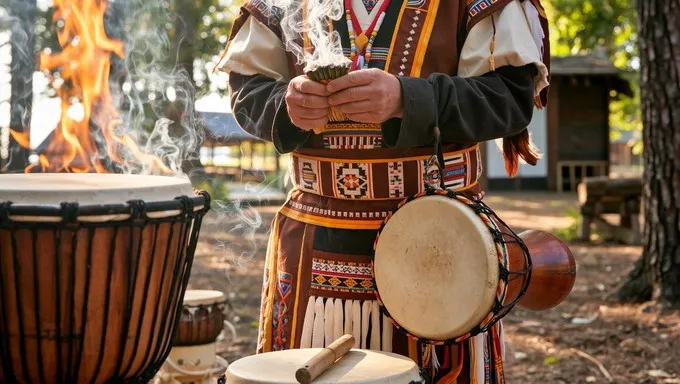
Photo: indigenous shaman drummer ceremonial percussion ritual drumming traditional, via images.stockcake.com
Open up pretty much any popular meditation app right now and scroll through the soundscape options. Somewhere between "Ocean Waves" and "Tibetan Singing Bowls," you'll probably find something described as "shamanic drumming" or "ancestral rhythm" — a steady, hypnotic beat that the app promises will help you "connect with ancient wisdom" or "enter a theta brainwave state" in about twelve minutes.
It sounds appealing. It also raises a whole lot of questions that the app's marketing copy isn't going to answer for you.
Shamanic drumming traditions are among the oldest musical practices on Earth. From the Siberian taiga to the Mongolian steppe to the indigenous communities of North and South America, rhythmic percussion has long served as a vehicle for healing, spiritual communication, and community ritual. These aren't just "sounds" in the aesthetic sense — they're technologies, developed and refined over millennia, embedded in specific cultural and spiritual frameworks that give them meaning.
So what happens when those sounds get extracted, repackaged, and sold as content?
The Wellness Industry's Percussion Problem
The numbers tell part of the story. The global wellness market was valued at over $5.6 trillion in 2022, and "sound healing" has been one of its fastest-growing subcategories. Apps like Calm and Insight Timer have seen massive upticks in users seeking "earthen" or "primal" soundscapes. Spotify's meditation and focus playlists regularly feature tracks built around drum patterns explicitly described as shamanic. High-end retreat centers in places like Sedona, Arizona and Woodstock, New York offer "shamanic drumming journeys" for several hundred dollars a session.
For many practitioners and ethnomusicologists, this rapid commercialization sets off serious alarm bells.
"The drum in these traditions isn't an instrument in the Western sense," explains one ethnomusicologist who has spent two decades studying indigenous musical practices across Central Asia and the Americas. "It's a relational object. It has a history, a spirit, a community attached to it. When you pull the sound out of that context and drop it into a wellness app, you're not just simplifying — you're fundamentally misrepresenting what the practice is."
The concern isn't merely academic. For many indigenous communities, the commercialization of sacred practices — including their music — is a continuation of a much longer history of extraction. Their knowledge systems, their healing technologies, their spiritual tools have been taken, rebranded, and sold back to them — or sold to others — without consent, compensation, or credit.
The Producers in the Middle
Not everyone working in this space is oblivious to those concerns. A growing number of sound designers and music producers are actively trying to navigate the ethics of working with sacred percussion traditions — with varying degrees of success.
Take the approach of producers who work closely with indigenous musicians as collaborators rather than sources. Some composers creating music for wellness platforms now insist on co-production agreements with community members, revenue sharing, and explicit cultural consultation as part of their process. They argue that there's a meaningful difference between sampling a recording without permission and building a genuine creative partnership.
"I won't release anything that uses ceremonial elements without explicit blessing from the community I'm working with," says one Brooklyn-based composer who creates therapeutic soundscapes for clinical settings. "That's not just an ethical position — it produces better work. When you actually understand what a rhythm means and where it comes from, you use it completely differently."
This kind of intentional collaboration is still the exception rather than the rule, but it points toward a model that takes both the music and its origins seriously.
What the Science Actually Says
Here's the part that complicates the ethical picture: the therapeutic applications of rhythmic percussion are genuinely well-supported by research. Studies in neuroscience and music therapy have found that steady, repetitive drumming at specific tempos can reduce cortisol levels, promote relaxation, and even support trauma processing. The "theta state" that those wellness apps are promising isn't marketing fluff — it's a real neurological phenomenon associated with deep relaxation and heightened creativity.
In other words, shamanic drumming traditions may have been onto something neurologically significant for thousands of years before Western science developed the tools to measure it. That's remarkable. It's also, ironically, part of why the commercialization pressure is so intense — the stuff actually works, which makes it enormously marketable.
The challenge is that the therapeutic value of a drumbeat doesn't require — and arguably doesn't justify — stripping away its cultural context. You can benefit from the neurological effects of rhythmic percussion without pretending that a 12-minute app session is equivalent to a Mongolian shamanic ceremony, or that buying a "shamanic drum" from a wellness boutique gives you access to the knowledge system it was developed within.
Artists Bridging the Gap
Some of the most interesting work happening at this intersection is being done by artists who are themselves part of the traditions they're drawing from — musicians who are finding ways to share their heritage with wider audiences without flattening it.
Native American artists like Saad Stormcloud and collectives within the broader indigenous electronic music scene are creating work that incorporates ceremonial percussion into contemporary production contexts while maintaining explicit connections to their cultural roots. Their releases often come with liner notes that provide cultural context, and they're vocal about the difference between their work and what they describe as "plastic shamanism" — the appropriation of indigenous spiritual aesthetics by non-indigenous wellness entrepreneurs.
Similarly, musicians from Tuvan and Mongolian traditions are increasingly releasing work through international labels that explicitly foregrounds the cultural context of their percussion practices, turning what could be passive listening into an education.
"I want people to hear this music and feel something," one Mongolian musician and composer told us. "But I also want them to understand that what they're feeling has a name, a history, a people behind it. That's not a burden — that's the gift."
Finding Your Footing as a Listener
For American audiences navigating this landscape, the path forward is less about guilt and more about intentionality. There's nothing inherently wrong with being moved by the sound of a frame drum or finding that rhythmic percussion helps you focus or unwind. The problem is passive consumption that treats these traditions as generic "ancient wisdom" — interchangeable, authorless, free for the taking.
The better move? Seek out artists who are rooted in the traditions they're working with. Read the liner notes. Support musicians directly. When a wellness platform offers you a "shamanic drumming" track, ask yourself who made it and what they were given in return.
The rhythm is real. The history behind it is richer than any app description will tell you. And the communities who developed these traditions over centuries deserve to be more than a background track in someone else's self-care routine.