Forty Folding Chairs and a Plane Ticket: How America's Living Rooms Became World Music's Warmest Room
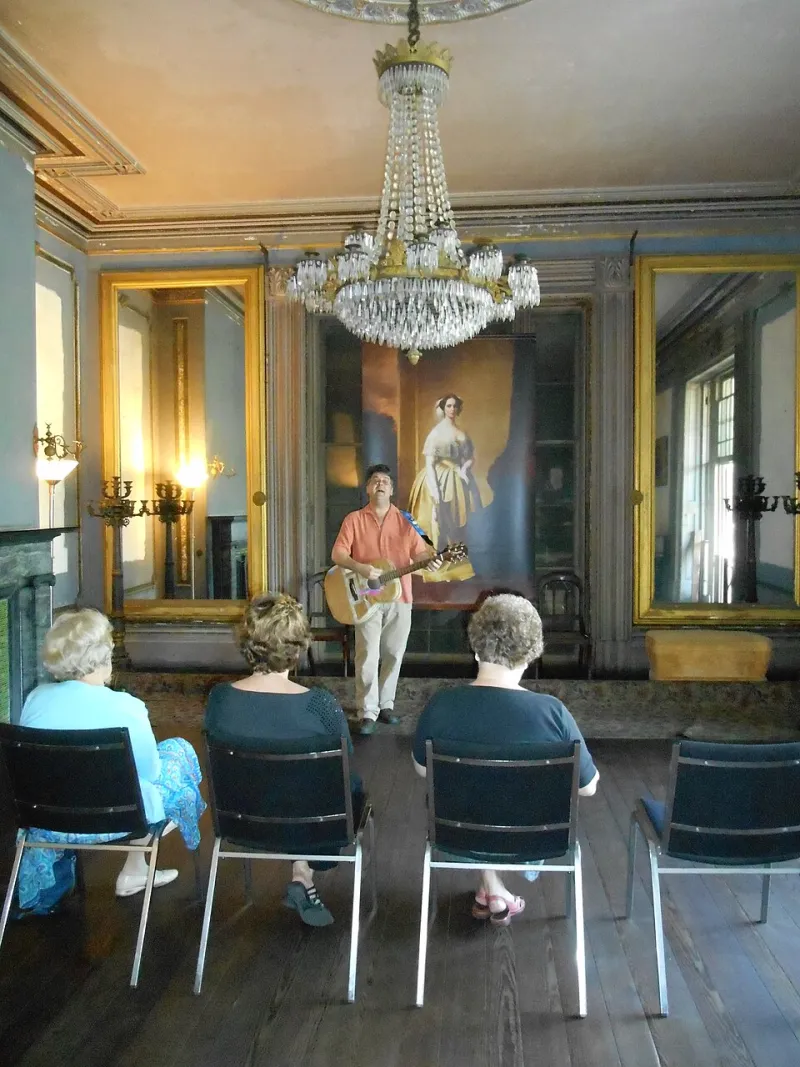
Photo: Nedhartley, CC BY-SA 4.0, via Wikimedia Commons
The first thing you notice in Renée Alcott's living room in Fort Wayne, Indiana, is that there is no stage. There is a rug, a lamp that gets moved, and about forty folding chairs borrowed from a church two blocks away. The second thing you notice is that nobody is talking over the music.
On a Friday night this fall, the room held a Tunisian oud player named Sami, touring the Midwest with a suitcase, a pickup, and no manager. He played for ninety minutes to people who had, for the most part, never heard an oud live before. When he finished, the room did that thing rooms do when everyone has been holding their breath politely — a half-second of silence, then a lot of noise.
This is the house-concert circuit, and if you don't live near one, you probably don't know it exists. It's a loose, mostly informal network of hosts who turn living rooms, backyards, porches, church basements, and the occasional converted garage into small venues. The acts are increasingly international. The audiences are increasingly local. And somewhere in the middle of that exchange, a whole alternative touring economy has taken shape.
The Economics of a Room That Isn't a Venue
Nobody's getting rich here, and that's partly the point. The math usually looks like this: a host sets a suggested donation — twenty, twenty-five dollars, sometimes a sliding scale — and caps attendance somewhere between thirty and sixty. The artist takes the door. The host covers the snacks, the chairs, and the fact that a stranger is sleeping in the guest room.
What that means in practice is that a musician flying in from Lisbon doesn't need to sell four hundred tickets to break even. They need forty people who each put a twenty in a jar. Add a merch table by the door — and there is always a merch table by the door — and a two-night stand in two different towns can pay for a week of travel.
"The venue model punishes anyone who isn't famous," says Priya Raman, who has hosted about sixty shows in her Cincinnati home since 2019. "A club needs to move a lot of drinks. A church hall needs a rental fee. My living room needs somebody to move the coffee table. That's a lower bar, and lower bars let in more of the world."
Who's Actually Booking This Stuff
Less glamorous than it sounds. Hosts tend to be teachers, retired librarians, amateur musicians, and the occasional couple who went to one show and got hooked. Many of them find acts through word of mouth — a friend of a friend in another city who hosted someone last season and vouches for them.
Some host networks run on email chains that predate social media and still work better than it does. Others organize through regional folk-alliance gatherings, where artists and presenters spend a weekend in hotel conference rooms essentially speed-dating each other into a tour route. Increasingly, hosts find artists through short clips online — which has its own problems, since a good fifteen-second clip does not reliably predict whether someone can hold a room for an hour and a half.
The best hosts function as unofficial tour managers: they find the next host, they post about the show, they know which local restaurant will feed a visiting musician at 10 p.m. on a Tuesday.
Why Mid-Size Cities Are the Point
Here's the odd arithmetic of American touring: the biggest markets are oversaturated, the smallest can't support a night, and the middle is where the interesting stuff happens. Cities like Boise, Tulsa, Spokane, Dayton, Chattanooga, and Akron have real audiences, real cultural curiosity, and no meaningful infrastructure for international acts who play to fewer than a thousand people.
That gap is where living rooms live.
"In a big city, you're competing with eleven other things happening that night," says a host in Spokane who asked not to be named because her homeowner's insurance is, in her words, 'a delicate subject.' "In a mid-size city, if an international musician shows up, that's the event. People bring neighbors. They bring their kids. They stay for the whole thing."
The Awkward Parts
The circuit has real friction. Visas remain the number-one headache — a house concert can't provide the paperwork a proper venue can, and artists from some countries simply route around the US altogether. Insurance is a perennial gray area. Nobody quite agrees on whether a suggested donation is a ticket, a gift, or a legal gray zone.
And there's the intimacy problem, which is also the whole appeal. An audience of forty in a living room is close enough to notice when a performer is having an off night. There's no lighting cue or bar crowd to hide behind. Some musicians thrive in that; others find it unnerving and go back to clubs.
What the Circuit Is Actually Building
Ask hosts what they think they're doing and you get variations on the same answer: building an audience, one room at a time, for music that American radio mostly ignores.
In Fort Wayne, Alcott keeps a guest book. It has signatures in Arabic, Finnish, Portuguese, and a lot of scrawled English from people who came because a neighbor asked. "Half the people in this room had never heard an oud," she said afterward, stacking chairs. "Now they have. That's not nothing. That's a hundred and sixty someones across the last year."
There's a version of this story where the living room circuit is a scrappy workaround, a temporary fix for a broken touring system. But after a decade of watching it grow, it looks less like a workaround and more like a parallel infrastructure — one built entirely out of strangers deciding their coffee table could move.