Ancient Frequencies, Modern Prescriptions: What Happens When Traditional Healing Music Enters the Hospital
In a room on the fourth floor of a major research hospital in Boston, a woman recovering from cardiac surgery is listening to a raga. Not a recording — a live performance, played on a sarod by a musician who trained for twenty years in the Hindustani classical tradition. Her blood pressure, which has been elevated since the procedure, drops measurably during the forty-minute session. Her nurse, who has watched this happen enough times to stop being surprised by it, notes the change in her chart.
This is not a scene from an alternative medicine brochure. It's a documented outcome from a clinical program that has been running for several years, part of a growing body of work examining what happens when ancient musical healing traditions encounter the rigorous measurement culture of Western biomedicine.
The results, to put it plainly, are making some very serious scientists pay very close attention.
What the Research Is Actually Saying
The neuroscience of music and health is not new territory. Researchers have been studying music's effects on the brain and body for decades, and the literature is substantial enough that most major medical schools now teach at least some version of music therapy as a recognized clinical modality. But what's shifted recently is the specific attention being paid to non-Western musical traditions — forms that were developed explicitly as healing technologies, sometimes over thousands of years, rather than as entertainment.
Indian classical music, particularly the raga system, has attracted significant scientific interest because of its extraordinarily precise relationship between musical structure and physiological effect. Different ragas are associated with different times of day, different emotional states, and — according to classical practitioners — different therapeutic applications. A growing number of researchers are finding that these associations aren't purely metaphorical.
Dr. Preeti Shankar, a neuroscientist at UC San Diego whose work bridges Western cognitive science and South Asian musical traditions, has spent years studying how specific raga structures affect cortisol levels, heart rate variability, and neural oscillation patterns. "What we're finding is that the classical Indian framework for categorizing musical effect has a level of physiological precision that Western music theory simply doesn't have," she says. "These traditions were doing empirical work before we had the instruments to measure what they were measuring."
The Drumming Rooms
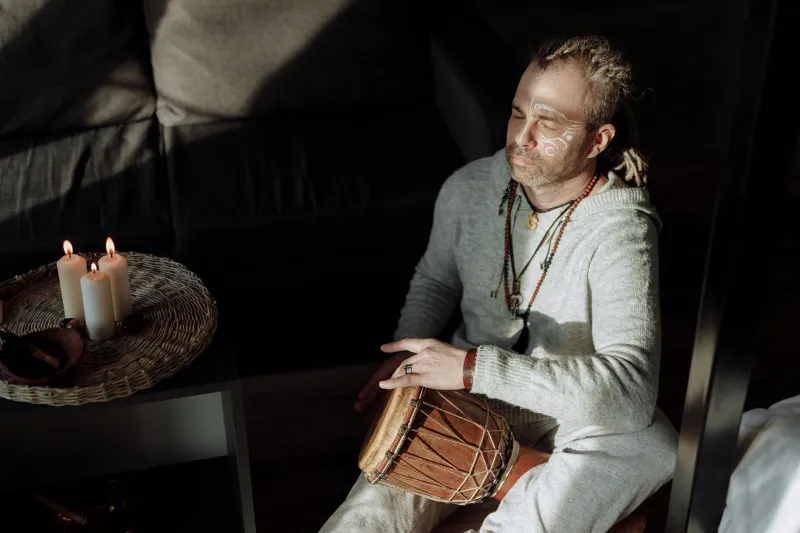
Across the country, a different kind of ancient music is finding its way into clinical settings. Indigenous drumming traditions — from Lakota ceremonial practice to Anishinaabe healing songs — are being incorporated into treatment programs at VA hospitals, addiction recovery centers, and trauma therapy clinics, often at the direct initiative of Native American healthcare advocates who have spent years pushing for culturally competent care.
The results in addiction and trauma treatment contexts have been striking enough to generate peer-reviewed attention. Several studies have documented significant improvements in treatment engagement, anxiety reduction, and long-term recovery outcomes among Native American patients who participate in drumming-based healing programs versus those receiving standard Western treatment protocols alone.
But the drumming rooms aren't only serving Native patients. At a VA hospital in Albuquerque, a drumming circle program that began as a culturally specific service for Native veterans has expanded to include non-Native participants, many of whom report outcomes that standard talk therapy and medication hadn't achieved. The program's director, a Diné (Navajo) veteran and certified music therapist named Raymond Begay, is careful about how he frames this.
"The drum has a specific cultural meaning and a specific ceremonial context," he says. "What we offer in a clinical setting is not the same thing as a ceremony. It's an adaptation. I think it's an honest and respectful one, but I also think it's important to be clear about what it is and what it isn't."
The Commodification Question
And here is where the story gets complicated — because it always gets complicated at the intersection of sacred tradition and American commercial culture.
As traditional healing music gains credibility in medical and wellness contexts, it's also gaining visibility in the broader wellness industry: the apps, the subscription services, the spa soundtracks, the "healing frequency" playlists that rack up millions of streams on Spotify. West African sound bath practitioners, whose work draws on specific Yoruba and Dagomba musical healing traditions, are increasingly finding their practices repackaged and sold by wellness entrepreneurs who may have attended a weekend workshop and now offer "African-inspired sound healing" at $150 a session.
This is not an abstract concern for the practitioners whose traditions are being borrowed. Many of them have spent lifetimes in apprenticeship to master healers, learning systems that are inseparable from specific cultural and spiritual frameworks. When those systems are extracted from their context, simplified, and monetized by outsiders, something is lost — and someone is profiting from knowledge they didn't earn.
"There's a version of this that honors the tradition and a version that exploits it," says Abena Asante, a Ghanaian-American practitioner of Akan healing music practices who works with a community health clinic in Atlanta. "The difference usually comes down to whether the people whose tradition it is are in the room, whether they're being compensated, and whether the cultural context is being taught alongside the technique."
The wellness industry, predictably, is not always great at making those distinctions.
A Two-Way Education
For all the legitimate concerns about appropriation and commodification, there's something genuinely worth celebrating in the broader conversation these developments are forcing. Western medicine's encounter with traditional healing music is producing a two-way education that is, at its best, genuinely enriching both sides.
Western neuroscience is gaining new frameworks for understanding music's physiological effects — frameworks developed through centuries of careful, if non-laboratory, empirical observation. Traditional practitioners, meanwhile, are gaining access to measurement tools that can document and communicate the efficacy of their work in ways that open institutional doors and, critically, expand access to communities that need healing.
The woman recovering from cardiac surgery in that Boston hospital room didn't know the name of the raga being played for her. She didn't know its history, its theoretical structure, or its place in a tradition stretching back over a thousand years. She just knew that something shifted in her body when she heard it, and that she felt, for the first time since the surgery, like she might actually be okay.
That's not nothing. That's, in fact, exactly what music has always been for.