Why Gen Z Is Digging Through Their Parents' Record Crates — And It's Not About the Music
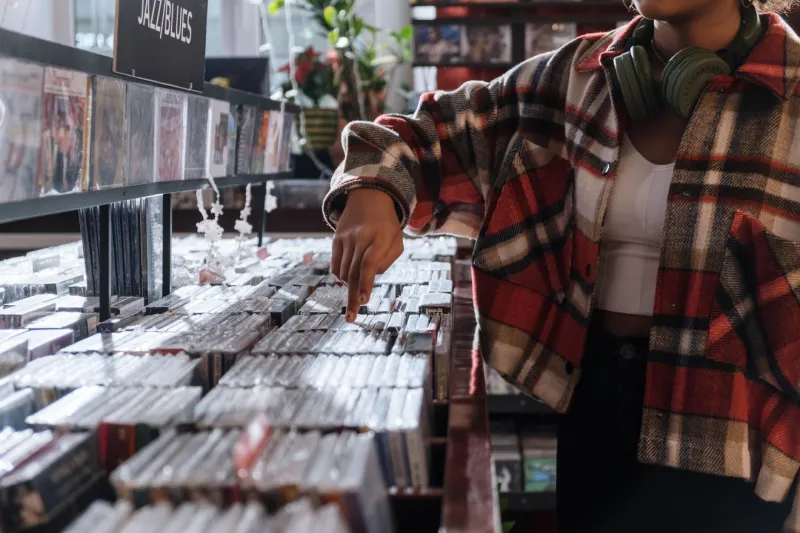
Something strange is happening in American record stores. The customers flipping through crates of used vinyl — examining gatefold sleeves, reading liner notes, debating the relative merits of different pressings — are increasingly not the fifty-year-olds you'd expect. They're twenty-two. They're nineteen. They're wearing band shirts for groups that broke up before they were born, and they're completely serious about it.
The numbers back this up. Vinyl sales in the US have grown for seventeen consecutive years, with the most recent data showing that Gen Z now represents one of the fastest-growing buyer demographics in the physical music market. Streaming data tells a parallel story: tracks from the 1970s through the early 2000s are pulling enormous numbers from listeners born after the millennium. Fleetwood Mac's 'Dreams' went viral on TikTok in 2020 and hasn't really stopped. Kate Bush's 'Running Up That Hill' hit number one in the US in 2022, forty years after its release, driven almost entirely by young listeners.
The easy explanation is nostalgia. But Gen Z has no memory of this music's original context. They didn't hear 'Dreams' on the radio in 1977. They didn't watch Kate Bush perform on Top of the Pops. Whatever is pulling them toward these songs, it isn't remembering. So what is it?
The Algorithm Made Them Do It (Sort Of)
To understand the appeal of the old, you have to understand the experience of the new. Gen Z grew up inside algorithmic music discovery — Spotify's Discover Weekly, YouTube autoplay, TikTok's For You page. These systems are extraordinarily good at serving listeners more of what they've already responded to. They are extraordinarily bad at offering genuine surprise, context, or the sense that music exists within a larger cultural story.
What the algorithm delivers is an endless, undifferentiated stream. Songs appear and disappear. There's no before or after, no arc, no reason why this song follows that one except that a model predicted you'd keep listening. For a generation that has never known music consumption any other way, the experience can feel — even if they can't articulate it — profoundly unmoored.
An album from 1975 offers the opposite experience. It has a beginning and an end. It was made by specific people in a specific place at a specific moment in history. The songs relate to each other by design. The artist had something to say across the full length of the record, and the record contains that statement completely. It is, in the most literal sense, finished. Nothing about it is going to change based on your listening history.
Permanence as a Product
There's a concept in psychology called 'temporal self-appraisal' — the way people evaluate themselves and their choices in relation to time. Research consistently shows that uncertainty about the future pushes people toward objects and experiences that feel stable and permanent. When the path ahead is unclear, the past becomes unusually attractive — not because the past was better, but because it's settled. It already happened. It can't be taken away or updated or discontinued.
Gen Z is coming of age in a moment of extraordinary instability. Climate anxiety, economic precarity, political polarization, a pandemic that restructured their formative years — the list of reasons to feel like the ground is shifting is long and well-documented. The music they're reaching for isn't random. It's music that belongs to a completed era, music with a known outcome, music that has already been judged and found to have lasted.
A vinyl copy of Rumours isn't just an album. It's a physical object that has survived fifty years and will probably survive fifty more. It exists in a way that a Spotify playlist does not and cannot. You can hold it. It has weight. In a culture where the average streaming track gets skipped in the first thirty seconds and playlists are rebuilt by machine every week, that weight means something.
The TikTok Paradox
Here's the wrinkle: most of Gen Z's engagement with retro music happens on TikTok, the most algorithmically chaotic platform in existence. The same app that epitomizes the ephemerality they're reacting against is also the primary vector through which they're discovering Talking Heads and Carole King.
This isn't as contradictory as it looks. TikTok's format actually suits older music well. A fifteen-second clip of a chorus from 1983 carries an immediate emotional punch that doesn't require context. The platform strips songs down to their most viscerally effective moments, and music that was built on strong melodic hooks and live instrumentation — the hallmarks of the era Gen Z is gravitating toward — tends to translate well to that format.
But the discovery on TikTok often leads somewhere else. Users find a snippet, get curious, look up the full song, find the full album, and then — increasingly — decide they want to own it. The physical object becomes the antidote to the platform that introduced them to it. TikTok is the doorway; the record store is the destination.
What They're Actually Buying
It's worth being specific about what's selling, because the taste patterns reveal something. The decades getting the most attention from young buyers aren't uniform. The 1970s — classic rock, soul, funk, early electronic — are enormously popular. So is the 1990s, particularly alternative rock and R&B. The early 2000s are having a moment, driven partly by Y2K aesthetic cycles in fashion and partly by genuine musical interest.
What these eras share, beyond their distance from the present, is a sense of completeness. These weren't transitional moments in music history — they were periods with distinct, fully developed aesthetics that had time to mature before the next thing arrived. The 1970s had a decade to be itself. So did the 1990s. The 2010s, by contrast, feel to many young listeners like a blur of micro-trends that each lasted eighteen months before the algorithm moved on.
The appeal of a defined era isn't just aesthetic. It's structural. If you're a twenty-year-old trying to develop a musical identity, a completed decade is easier to inhabit than an ongoing stream. You can know the 1990s. You can become fluent in it. You can own it in a way that the present, with its relentless churn, doesn't allow.
The Physical Object as Cultural Anchor
Record store owners across the country are reporting the same phenomenon: young customers who are buying vinyl without owning turntables. They're acquiring the object before they have the means to play it, which tells you something important about what they're actually buying. It's not primarily a listening format. It's an artifact. A thing that proves the music was real, that it existed in physical space, that it can't be deleted from a server or removed from a platform.
This is a generation that has watched streaming services lose licensing rights and pull entire catalogs overnight. They've seen social platforms disappear, taking years of content with them. They understand, viscerally, that digital things are temporary in a way that printed things are not. A record is a hedge against that impermanence.
Not Nostalgia, But Archaeology
The word 'nostalgia' implies longing for something you've lost. What Gen Z is doing is closer to archaeology — digging through a past they never inhabited, looking for objects that carry the weight of permanence they're not finding in their own moment.
The music itself is often secondary. What they're after is the feeling of something that was built to last, in an era when nothing digital comes with that guarantee. The rhythm they're looking for isn't in the groove of the record. It's in the fact that the record exists at all, forty years later, unchanged and unchangeable.
That's not nostalgia. That's hunger. And it says a lot about what the present is failing to provide.